Species Diversification as Climate Adaptation in Perennial Systems: Trading off Annual Costs for Long-term Resilience Benefits
Presented at: Heartland Environmental and Resource Economics Workshop (2026, scheduled), JEEM/REE Workshop on Nonmarket Valuation (2026), World Congress of Environmental and Resource Economists (WCERE) (2026), Program in Environmental and Resource Economics (pERE), UIUC (2025), Annual BIOECON Conference (2025)
Draft available upon request
Abstract
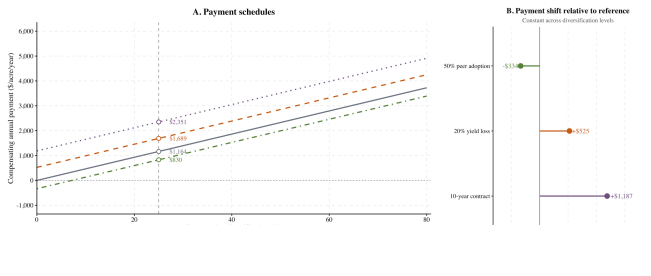
Species diversification can enhance the resilience of agroecosystems to climate-related shocks and serve as a climate adaptation strategy. We study how producers in perennial systems weigh the annual costs against the delayed resilience benefits of species diversification, and how climate projection information shifts this trade-off. Given that private investments in resilience generate public good benefits, we test whether producers view diversification by others as strategic complements or substitutes. This paper develops a dynamic optimization model of a producer choosing the optimal diversification intensity and tests its predictions with U.S. maple producers using a discrete choice experiment with a randomized climate information treatment. The annual payment required rises by about $47 per acre for each percentage point increase in diversification intensity. Although longer contracts align commitments with the long-term horizon of resilience benefits, older producers require more than twice the additional payment relative to their younger peers and most of them prefer to keep their current monocultures, a status quo bias driven by their age. Producers view diversification by peers as a strategic complement to their own investments, reducing required payment by 29% when 50% of peers have diversified. Through a salience effect, region-specific climate projection information provisioning increases the weight producers place on future resilience benefits and reduces their sensitivity to annual yield losses. These results show three strategies for conservation programs seeking to increase agroecosystem resilience through species diversification to lower their costs: offering flexible contract terms, coordinating adoption among neighbors, and pairing payments with targeted climate information.